How to Fill Out a Void Check A Simple Guide
So, you need to void a check. It’s a straightforward process, but getting it right is key.
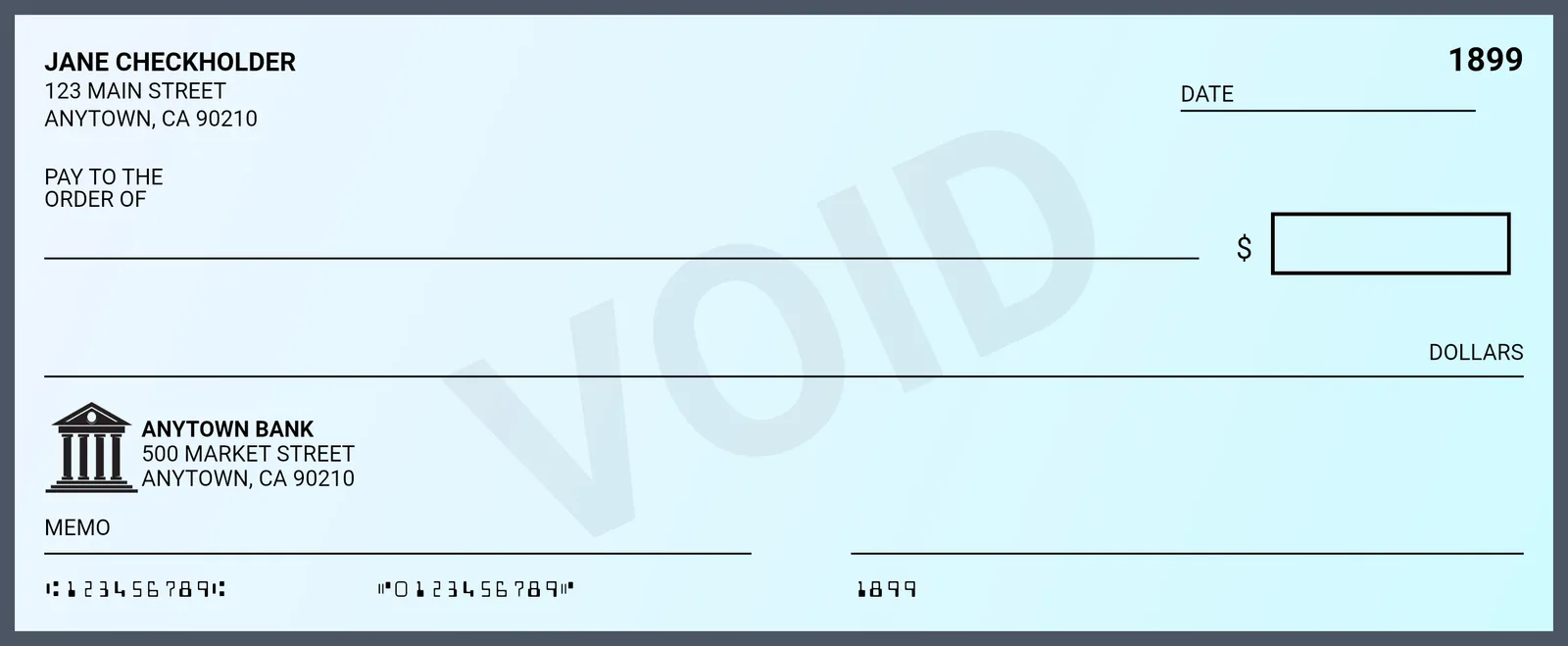
Grab a blue or black pen and write "VOID" in big, bold letters across the face of the check. You'll want to make sure your writing stretches over the main fields—the payee line ("Pay to the order of"), the date line, the amount box, and especially the signature line.
The goal here is to clearly disable the check so it can't be filled out and used for payment. At the same time, you must keep the crucial numbers at the bottom—your bank’s routing number and your account number—completely visible and readable. Don't sign it or write anything else.
Why Do I Still Need a Voided Check?

It seems a bit old-school, doesn't it? In a world of apps and digital wallets, the idea of using a paper check for anything can feel like a throwback. But a voided check still plays a vital role in setting up some of the most common and important financial connections. It’s the tried-and-true method for authorizing electronic fund transfers (ACH) and direct deposits.
The Role of a Voided Check
Picture this: you've just landed a great new job. The HR department needs to set up your direct deposit. How do they make absolutely sure your hard-earned money is going into the right account? They ask for a voided check. The same thing happens when you want to set up automatic payments for your mortgage, rent, or a car loan.
A voided check acts as a physical, verifiable link to your bank account. Sure, you could just jot down your routing and account numbers on a form, but a simple typo could send your money into the wrong hands or cause significant delays. A printed check from your bank confirms everything—your name, your account details, and the bank’s information—all in one place.
This process is a safety net for several key financial setups:
- Setting Up Direct Deposit: This is the most common reason you'll need one. It’s how employers guarantee your paycheck lands where it should.
- Arranging Automatic Bill Payments: Companies use it to pull funds for recurring expenses like utilities, rent, or loan payments.
- Linking Other Financial Accounts: When you want to connect your checking account to a brokerage or high-yield savings account, a voided check can often simplify the verification.
A voided check is all about preventing errors. It’s the definitive proof that the account and routing numbers are correct and belong to you, saving everyone the headache of a misplaced payment due to a simple transcription mistake.
What if You Have No Checks?
Here’s where things get tricky for many people today. With the rise of online banking, fewer and fewer of us keep a physical checkbook on hand. So, what do you do when an employer or a company asks for a voided check you don't have?
Don't worry, you're not stuck. This is a common issue, and modern solutions have emerged to solve it. You can now generate a perfectly compliant voided check without ever having to order a checkbook or make a trip to the bank.
Understanding the Anatomy of a Check

Before you can confidently void a check, it helps to know your way around one. A check isn't just a simple piece of paper; it’s a financial document with very specific fields that all serve a purpose. Getting familiar with what each section does is the first step to voiding one correctly and safely.
Think of it like a map for your money. Each part provides critical information that your bank, and the recipient's bank, uses to process a transaction. While your main goal is to make sure this particular check can't be used for payment, all the underlying account details need to stay perfectly clear for verification.
Key Sections of a Check and Their Purpose
To understand what you're disabling, let's break down the key parts of a check. Most of these fields are related to payment authorization, which is why you'll be writing "VOID" across them. But the numbers at the bottom are what you're really trying to share.
| Check Section | Purpose | Action When Voiding |
|---|---|---|
| Payee Line | Specifies who the check is payable to. | Cover with "VOID" |
| Amount Box | Displays the payment amount in numbers (e.g., "$150.50"). | Cover with "VOID" |
| Amount Line | Spells out the payment amount in words. | Cover with "VOID" |
| Signature Line | Authorizes the payment with your legal signature. | Cover with "VOID" |
| Routing Number | Identifies your bank or financial institution. | Leave clear and readable. |
| Account Number | Identifies your specific account at that bank. | Leave clear and readable. |
As you can see, the goal is to disable the payment fields while preserving the identifying numbers.
The Most Important Numbers on Your Check
Now, let's focus on the real stars of the show: that string of numbers printed in special magnetic ink at the bottom of every check. This is the information your employer or a billing company is actually after. They need these two numbers to set up an electronic link to your account for direct deposits or automatic payments.
- The Routing Number: This is always a nine-digit number and acts as your bank's address. It tells other financial institutions exactly where to find your account in the vast banking system.
- The Account Number: This is your unique identifier at that specific bank. It ensures money is directed to or from the right place—your account and no one else's.
When you void a check, your top priority is to make sure these two crucial numbers are not covered, smeared, or altered in any way. If they're unreadable, the check will be rejected, and you’ll find yourself having to do this all over again.
Pro Tip: The whole point of providing a voided check is to safely transmit your banking coordinates. Those routing and account numbers are the entire reason you're handing it over in the first place.
For anyone who doesn't have a physical checkbook handy, you can see a perfect example of how these numbers are formatted on a blank voided check template, which can be a helpful reference.
How to Void a Check The Right Way

So, you've been asked for a voided check and now you're wondering how to actually do it. The good news is that it’s incredibly simple. The entire process takes less than a minute, but doing it correctly can save you from major headaches later on.
First things first, get the right tool for the job. You’ll need a pen with blue or black ink. This is non-negotiable. Permanent ink ensures the marking is clear, won't smudge, and can't be erased or altered. Whatever you do, don't use a pencil or one of those erasable pens.
Now for the main event: write the word VOID in large, clear capital letters across the front of the check. You want it to be immediately obvious that this check can't be used for payment, but you also need to avoid covering up the important numbers at the bottom.
Mastering the Voiding Technique
The best way to void a check is to write "VOID" diagonally, stretching from the bottom-left corner up toward the top-right. This angle is strategic—it effectively crosses out all the payment fields you need to disable.
Make sure your "VOID" marking covers these specific areas:
- The Payee Line (where it says "Pay to the order of")
- The Amount Box (the small box for the dollar amount)
- The Amount Line (where you'd write the amount in words)
- The Signature Line
By covering these fields, you've rendered the check financially useless. No one can add a name, write in an amount, or forge a signature to cash it. Crucially, this diagonal line leaves the most important information—your routing and account numbers at the bottom—completely clear and easy to read.
Crucial Takeaway: The goal here is a careful balance. You want to clearly disable the check for payment while keeping the banking details perfectly legible for verification.
This method works for both physical checks and digital templates. Whether it's a real check from your checkbook or a PDF you generated online, it must have "VOID" displayed boldly across its face. This is especially relevant for the 39% of consumers who don't use checkbooks anymore and rely on digital options. Clear markings are what make these digital versions acceptable to HR departments. You can find more data on modern check usage trends to see just how common this has become.
Beyond Just Writing VOID
Once you've marked the check, don't hand it over just yet. A couple of quick final steps will protect your information and make sure everything goes smoothly.
Before sending it off, always make a copy for your own records. A quick photocopy or even a clear photo with your phone is all you need. This creates a personal record of what you provided and who you gave it to, which can be a lifesaver if any issues pop up down the road.
If you're sending it digitally, be smart about security. Instead of just attaching it to a regular email, use a secure file transfer service if one is available—especially if you're not 100% sure about the recipient's email security. And a golden rule: never send financial documents while connected to public Wi-Fi.
Following these simple but essential steps ensures your voided check does its job for verification while keeping your financial information safe from misuse.
When You Might Need a Voided Check

It might seem a little old-school, but there are plenty of reasons someone might ask you for a voided check. Think of it less as a payment method and more as a verifiable snapshot of your bank account information. It’s a simple, effective way to prove you own the account and prevent costly mistakes that can happen when account and routing numbers are just jotted down.
One of the most frequent reasons you’ll need one is for setting up direct deposit. If you’re starting a new job, the HR department will almost definitely ask for a voided check. It gives them a foolproof way to get your payroll information right so your salary lands in your account without a hitch. This is a huge deal for payroll systems, especially since ACH direct deposits now handle over 80% of U.S. payroll by value. You can read more about how payroll systems have evolved on Orbograph.com.
Setting Up Automatic Payments
Beyond getting paid, voided checks are a go-to for setting up automatic bill payments. When you hand one over, you’re essentially giving a company a secure key to your account for a specific, recurring purpose. This process is officially known as an ACH (Automated Clearing House) authorization, and it’s the backbone of most automated payment systems.
You’ll run into this when setting up payments for major life expenses:
- Monthly Rent or Mortgage: Most landlords and lenders need that voided check to confirm your account details before they can start pulling your monthly payments.
- Car Loans: Setting up recurring debits for your car payment almost always requires account verification, and a voided check is the standard way to do it.
- Utility Bills: Your power, water, or internet provider will often ask for one to establish automatic withdrawals, saving you the hassle of paying manually each month.
In all these scenarios, the voided check is the gold standard for accuracy. It’s a physical (or digital) guarantee that the numbers are correct.
By providing a voided check, you are giving the requesting company an official, bank-verified document. This drastically reduces the risk of typos or fraud, protecting both you and the payment processor.
Other Important Financial Scenarios
The usefulness of a voided check doesn't end with payroll and bills. It's a standard tool across the financial industry for confirming account ownership before any money changes hands.
Here are a few other times you might be asked for one:
- Linking to an Investment Account: Brokerage firms like Fidelity or Vanguard often require a voided check to link your bank account for deposits or withdrawals.
- Receiving Government Payments: If you’re expecting a tax refund or other government benefits, providing a voided check is a common way to set up the direct deposit.
- Setting Up Third-Party Payment Apps: While many apps use instant verification, some still rely on a voided check during initial setup to confirm your primary funding source.
Knowing when you might need a voided check makes it clear why it’s still such a relevant skill. It's all about creating a secure, error-free link between your bank account and the services you count on.
No Checkbook? No Problem. Here's What to Do.
It’s a situation I see all the time. You just landed a great new job or need to set up automatic bill pay, and you get asked for a voided check. Your first thought? "I haven't owned a checkbook in years." With digital banking being the norm, most of us simply don't have physical checks lying around anymore.
So, what are your options when this happens?
For a long time, the go-to solutions were a real hassle. You could drive to your bank and wait in line for a teller to print a counter check for you. Or you could try your luck navigating your online banking portal, digging through menus to find a pre-filled direct deposit form that might work.
Both of these methods get the job done, but they’re inconvenient and slow. In a world where we handle almost everything else instantly from our phones, these old-school fixes feel out of place.
A Smarter, Digital-First Approach
Thankfully, there's a much faster and simpler way to handle this now. The best solution today is to use a secure online tool to generate a professional voided check instantly. Forget the trip to the bank or the confusing website.
This is exactly what services like VoidedCheck.org were built for. In less than a minute, you can create a perfectly valid, professional-looking voided check PDF. All you have to do is enter your account information, and the platform handles the rest, giving you a document ready to send.
Why is this the better way?
- It’s Fast and Easy: You can create a check from anywhere, on any device.
- It Looks Professional: The PDF is clean, easy to read, and has all the necessary information.
- It’s Instant: No more waiting. You get the file immediately and can move on with your onboarding or payment setup.
How These Tools Keep Your Information Safe and Accurate
These modern solutions are built with security and accuracy as top priorities. When you use a trusted service, your data is protected with the same kind of security your bank uses.
For instance, VoidedCheck.org uses 256-bit SSL encryption to secure your information while you're creating the check. Crucially, your sensitive financial details are never stored on their servers, which gives you complete peace of mind. The platform also checks your bank's routing number against the official Federal Reserve database to make sure every detail is accurate and will be accepted without a hitch.
This move to digital tools just makes sense. With 55% of bank customers now using mobile apps for their banking, instant online services are a perfect fit. It’s also a safer bet, as check fraud remains a serious problem—reports actually doubled in 2022, affecting 65% of organizations. You can get more details on personal check use trends from Orbograph.com.
By using a secure generator, you’re not just saving time; you’re also using a safer method. It’s a modern fix that closes the gap for anyone who has ditched paper checks but still needs a reliable way to provide their banking details.
See for yourself how easy it is to create a digital voided check—it’s quickly become the go-to choice for a reason.
Got More Questions About Voiding Checks?
It's completely normal to have a few more questions, even after you've got the basics down. When it comes to your banking info, it pays to be careful. Let's tackle some of the most common hang-ups people run into.
Can't I Just Write My Account and Routing Numbers on a Piece of Paper?
You'd think so, right? It seems so much easier to just scribble down the numbers. But the reality is, most employers or companies will turn it down flat.
A voided check isn't just about the numbers; it's official proof from the bank that the account actually belongs to you. This simple requirement helps them avoid fraud and, just as importantly, simple typos that could send your money to the wrong place. If you just hand over handwritten numbers, you’re almost guaranteeing a delay while they ask for the proper document.
How Safe Is It to Email a Voided Check?
Sending a picture of your voided check over email is pretty standard these days, but you absolutely need to be smart about it. That check is a direct line to your bank account.
Before you hit send, run through this quick mental checklist:
- Double-check the email address. Are you sending it to a legitimate, trusted recipient? A typo could send your info to a complete stranger.
- Avoid public Wi-Fi. Never send sensitive documents from a coffee shop or airport network. These are prime spots for security risks.
- Look for a secure portal first. Many HR departments have a secure online portal for uploading documents. That's always a safer bet than email.
A little bit of caution goes a long way here. Taking an extra 30 seconds to confirm you're sending your info securely can save you from a massive headache down the road.
Whoops, I Messed Up. What Now?
It happens. Maybe your pen slipped and you wrote "VOID" right over your account number. Whatever the mistake, don't reach for the white-out or try to scribble over it. A check that looks altered or messy will almost always get rejected.
The only real solution is to start over. Shred the messed-up check completely and grab a new one. This time, take a moment to be deliberate with where you write. If you're using a digital tool, of course, you can just fix the error and generate a new one instantly—no paper wasted.
Does the Check Number on a Voided Check Matter at All?
Nope, not in the slightest. The check number up in the top-right corner is for your personal record-keeping, nothing more.
When you hand over a voided check, the only things the recipient cares about are the bank's routing number and your account number at the bottom. You can pull any check you want from your checkbook—the first, the last, it makes no difference.
Still don't have a checkbook handy or just want to get this done fast? You can use VoidedCheck.org to create a perfectly compliant voided check in about 60 seconds. It's all done online, and you get a secure PDF you can send right away.
Related Articles

Generate Check Online: Create a Check in Seconds (generate check online)
Need to generate check online? Learn a fast, secure way to create a check for direct deposit or bill pay with our step-by-step guide.

How to create voided check online Instantly
Learn how to create voided check online for direct deposits or ACH payments. Our secure, step-by-step guide makes it fast and easy.

A Practical example of voided check: how to void and set up payments
Looking for an example of voided check? This step-by-step guide shows how to void a check correctly and offers safe, modern direct deposit alternatives.